Network and speedsBackground
Starlink's 2.5-hour global outage: what travelers learned
Starlink went down worldwide on July 24, 2025 from about 3 p.m. Eastern for roughly 2.5 hours. A Starlink engineering vice president blamed a failure of internal software that runs the core network, Reuters reported.
- First reported
- Posted
- Updated
Research and spec-based analysisUS only. Not tested on the road by us.
What happened
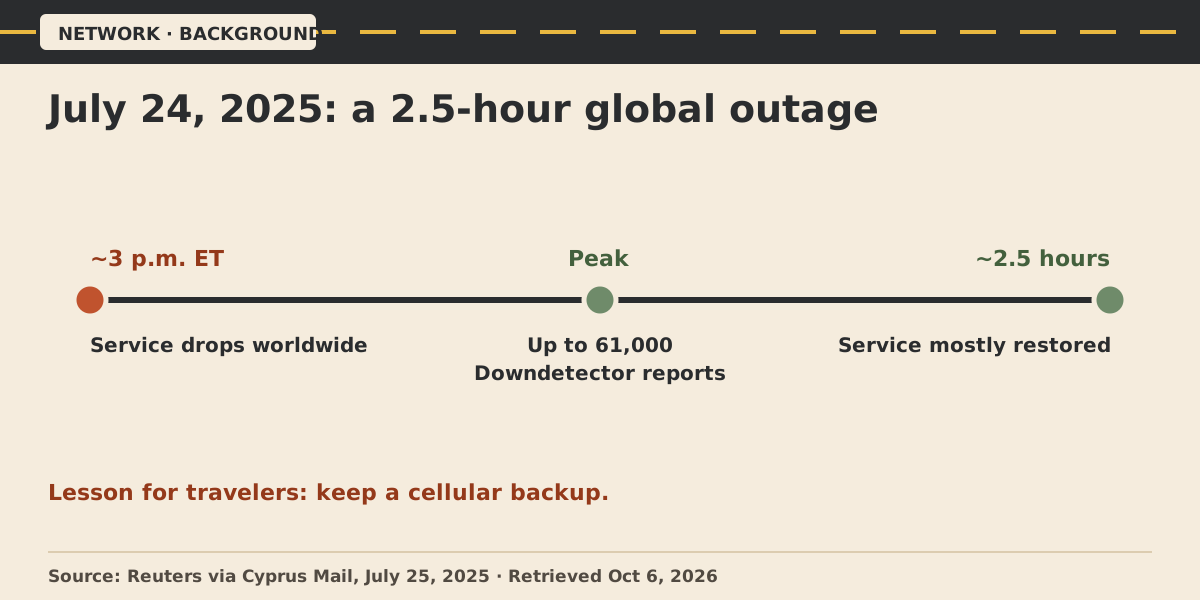
Reuters reported on July 25, 2025 that Starlink suffered “one of its biggest international outages” the day before, July 24, 2025. Key points from the report:
- Users in the US and Europe began losing service around 3 p.m. EDT (19:00 GMT).
- Downdetector, which counts user reports, logged as many as 61,000 reports.
- Service mostly resumed after about 2.5 hours, according to Michael Nicolls, Starlink’s vice president of engineering.
Nicolls gave the cause on X, as quoted by Reuters:
“The outage was due to failure of key internal software services that operate the core network.”
Elon Musk also apologized and said SpaceX would fix the root cause.
Reuters described it as a global outage. The failure was in the core network, not weather, trees or a single dish, so it wasn’t limited to one region or one kind of plan.
Who was affected
Everyone online through Starlink at that hour, including:
- Full-timers working from the road who lost a work afternoon.
- Boaters offshore, for whom Starlink is often the only link.
- Boondockers far from cell towers.
What it means for you
Reuters called the outage rare. But a 2.5-hour network-wide outage shows that a single connection, however good, is still a single point of failure.
What you can do:
- Keep a second path. A phone hotspot or a dedicated cellular plan covers most outages near towns. Our RV internet comparison explains how cellular and satellite fit together.
- Consider automatic failover. A dual-WAN travel router can switch to cellular when Starlink drops, and back again. See RV travel routers: cellular plus satellite.
- Know how to tell an outage from a local problem. If your dish shows connected but nothing loads, and friends on Starlink elsewhere have the same issue, it’s probably the network. Our troubleshooting page covers the local causes first: trees, plan limits and being abroad.
- For safety-critical needs, don’t rely on one service. A personal locator beacon doesn’t depend on any internet service. Note that T-Mobile’s T-Satellite texting runs on Starlink satellites, so don’t count on it as an independent backup.
What stays the same
- Starlink’s plans and rules did not change because of the outage.
- Nothing about your dish or setup caused it, and nothing on your side would have prevented it.
How we handled this report
This is background: it happened more than a year before we posted. We include it because it’s the clearest example of why our guides recommend a backup connection. Our source is a Reuters story republished by Cyprus Mail, with direct quotes from Starlink and SpaceX leaders.
Source
Musk's Starlink network suffers rare global outage (Reuters), Cyprus Mail, republishing Reuters, dated . Press report: facts from it are marked “reported”. Retrieved .
What we don’t know yet
- Whether Starlink published a full root-cause report. We found statements on the day, not a later report.
- Whether any customers got bill credits. The coverage we read doesn't say.
Correction log
Independent · not affiliated with SpaceX or Starlink. Starlink and Roam are trademarks of Space Exploration Technologies Corp. Starlink RV USA is not affiliated with, endorsed by, or sponsored by SpaceX or Starlink. Starlink links in this article use the site owner’s own referral link: the owner may get a referral reward if you order, your price is the same, and it never decides what we report. Nobody paid for this article. It is general information, not legal advice; Starlink can change prices and rules at any time. How we make money · How we research.